
Introduction
In the modern software development landscape, microservices architecture has become the go-to approach for building large-scale, scalable applications. Instead of developing massive monolithic systems where all features are tightly coupled, organizations are increasingly adopting microservices—a methodology that breaks applications into smaller, independent services that work together.
If you're building a new product or scaling an existing one, understanding microservices architecture is essential. This comprehensive guide will walk you through everything you need to know about microservices, from the basics to advanced implementation strategies.
What is Microservices Architecture?
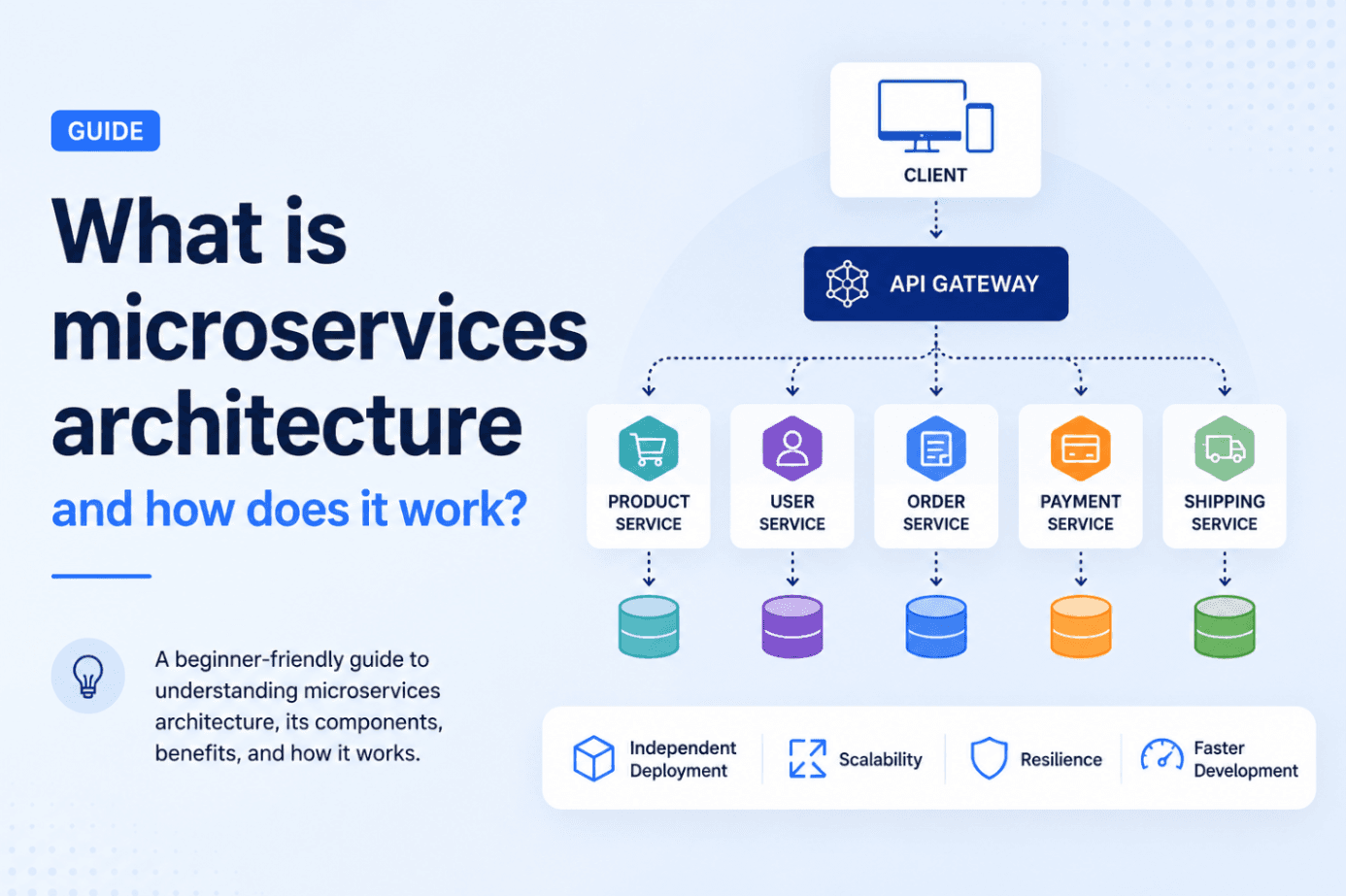
Microservices architecture is an approach to developing a single application as a suite of small services, each running in its own process and communicating with lightweight mechanisms—typically HTTP/REST or message queues. These services are built around specific business capabilities and can be deployed independently.
Think of it like a restaurant's kitchen. Instead of having one chef handle everything, you have specialized chefs for different stations: one for appetizers, one for main courses, one for desserts. Each station operates independently, takes orders, prepares food, and serves customers. Similarly, in microservices, each service handles a specific function.
Key Characteristics:
Independent Deployment: Each microservice can be developed and deployed independently without affecting others
Technology Agnostic: Different services can be built using different programming languages and frameworks
Loose Coupling: Services are loosely coupled and communicate through well-defined APIs
Focused Responsibility: Each service handles a specific business capability (Single Responsibility Principle)
Scalability: Services can be scaled independently based on demand
Fault Isolation: Failure in one service doesn't necessarily crash the entire system
How Microservices Architecture Works
Understanding the mechanics of microservices is crucial for successful implementation. Here's how the architecture typically functions:
1. Service Decomposition
The first step is breaking down your application into distinct services based on business domains. For an e-commerce platform, you might have:
User Service (authentication, profiles)
Product Service (catalog, inventory)
Order Service (order management, processing)
Payment Service (payment processing, transactions)
Notification Service (emails, SMS, push notifications)
// Order Service calling Product Service
GET /api/v1/products/SKU123
{
  "id": "SKU123",
  "name": "Laptop",
  "price": 999.99,
  "stock": 50
}
3. API Gateway
An API Gateway acts as the single entry point for all client requests. It:
Routes requests to appropriate services
Handles authentication and authorization
Performs rate limiting and load balancing
Aggregates responses from multiple services
Client Request → API Gateway → Routes to Microservice → Response4. Service Discovery
In dynamic environments, services need to locate each other. Service discovery mechanisms maintain a registry of available services and their locations:
Client-side Discovery: Client queries the service registry
Server-side Discovery: Router queries the service registry
Popular tools: Consul, Eureka, etcd, Kubernetes DNS
5. Data Management
Unlike monolithic applications with a single database, microservices use the "database per service" pattern:
User Service ← → User Database (PostgreSQL)
Order Service ← → Order Database (MongoDB)
Product Service ← → Product Database (MySQL)
6. Asynchronous Communication
For operations that don't require immediate responses, services use message queues:
Order Service → Message Queue (RabbitMQ/Kafka) → Notification Service
                                              → Inventory Service
                                              → Analytics Service
7. Containerization
Services are typically containerized using Docker:
dockerfile
FROM node:18
WORKDIR /app
COPY package*.json ./
RUN npm install
COPY . .
EXPOSE 3000
CMD ["npm", "start"]
8. Orchestration
Container orchestration platforms like Kubernetes manage deployment, scaling, and networking:
yaml
apiVersion: apps/v1
kind: Deployment
metadata:
  name: order-service
spec:
  replicas: 3
  selector:
    matchLabels:
      app: order-service
  template:
    metadata:
      labels:
        app: order-service
    spec:
      containers:
      - name: order-service
        image: myregistry/order-service:v1.0
        ports:
        - containerPort: 3000
Benefits of Microservices Architecture
1. Scalability
Scale individual services based on demand. If the payment service needs more resources during peak hours, only that service needs to scale up.
2. Technology Flexibility
Use the best technology for each service. Your payment service might use Go for performance, while your API might use Node.js.
3. Faster Development and Deployment
Teams can work independently on different services, reducing development cycles and enabling continuous deployment.
4. Resilience
Failure in one service doesn't necessarily crash the entire application. Implement circuit breakers and fallbacks.
5. Organizational Alignment
Teams can be organized around microservices, enabling better ownership and accountability.
6. Easier Updates and Maintenance
Services are smaller and easier to understand, test, and maintain compared to large monoliths.
7. Cost Optimization
Dynamically scale services, pay only for resources used, and optimize resource allocation.
Challenges of Microservices Architecture
1. Distributed System Complexity
Managing multiple services introduces network latency, reliability issues, and debugging complexity.
2. Data Consistency
Maintaining consistency across distributed databases is challenging. Implement eventual consistency patterns.
3. Testing Difficulty
Integration testing becomes complex with multiple services. Need comprehensive test automation.
4. Operational Overhead
Requires advanced DevOps practices, monitoring, logging, and sophisticated deployment strategies.
5. Network Overhead
Inter-service communication creates network latency. Minimize chatty interfaces.
6. Security Complexity
Managing authentication, authorization, and data security across distributed systems is more complex.
7. Service Dependency Management
Coordinating updates and managing version compatibility between dependent services is challenging.
Real-World Implementation Example
Let's look at how Netflix, a pioneer of microservices, implements this architecture:
Service Structure:
UI Service (Frontend)
API Gateway (Zuul)
User Service
Recommendation Service
Streaming Service
Payment Service
And hundreds more...
Technology Stack:
Java/Spring Boot for service development
Apache Kafka for asynchronous messaging
Cassandra for databases
Eureka for service discovery
Hystrix for fault tolerance
This allows Netflix to:
Deploy updates hundreds of times per day
Handle millions of concurrent users
Scale services independently during peak usage
Maintain high availability with 99.99% uptime
Best Practices for Microservices
1. Single Responsibility Principle
Each service should have one reason to change and one business capability.
2. API Versioning
Maintain backward compatibility or provide multiple API versions:
/api/v1/users (legacy)
/api/v2/users (current)
3. Comprehensive Logging and Monitoring
Implement distributed tracing to track requests across services:
Request ID: xyz-123
Service A → 50ms
Service B → 120ms
Service C → 80ms
Total: 250ms
4. Circuit Breaker Pattern
Prevent cascading failures:
javascript
class CircuitBreaker {
  async call() {
    if (this.state === 'OPEN') {
      throw new Error('Circuit breaker is open');
    }
    try {
      const result = await this.service();
      this.onSuccess();
      return result;
    } catch (error) {
      this.onFailure();
      throw error;
    }
  }
}
5. API Gateway
Use an API gateway to handle cross-cutting concerns:
Authentication
Rate limiting
Request/response transformation
Load balancing
6. Container and Orchestration
Use Docker and Kubernetes for consistent deployment and management.
7. Event-Driven Architecture
Use events for asynchronous communication between services.
8. Database Per Service
Avoid shared databases. Each service should own its data.
Migration Strategy: From Monolith to Microservices
Migrating from a monolithic architecture to microservices requires careful planning:
Phase 1: Assessment
Analyze current application
Identify service boundaries
Assess team readiness
Phase 2: Strangler Pattern Gradually extract services from the monolith:
Client → API Gateway
           ├→ Extracted Service (Microservice)
           ├→ Monolith (Original functionality)
Phase 3: Incremental Extraction
Extract one service at a time
Maintain backward compatibility
Test thoroughly
Phase 4: Full Migration
Move remaining functionality to microservices
Decommission the monolith
Tools and Frameworks
Service Development:
Spring Boot (Java)
Express.js (Node.js)
Django (Python)
Go (Golang)
API Gateway:
Kong
AWS API Gateway
Nginx
Traefik
Service Discovery:
Kubernetes Service Discovery
Consul
Eureka
Message Queue:
RabbitMQ
Apache Kafka
AWS SQS
Monitoring & Logging:
Prometheus
ELK Stack
Jaeger (Distributed Tracing)
Datadog
Orchestration:
Kubernetes
Docker Swarm
AWS ECS
Conclusion
Microservices architecture has transformed how we build scalable, modern applications. It's not a one-size-fits-all solution, but for complex, large-scale applications with multiple development teams, it offers significant advantages.
The key to successful microservices implementation is:
Understanding your application's business domains
Investing in proper DevOps infrastructure
Implementing comprehensive monitoring and logging
Following best practices for distributed systems
Starting small and evolving gradually
Whether you're building a new application or considering migration from a monolith, microservices architecture provides the flexibility, scalability, and resilience that modern applications demand.