
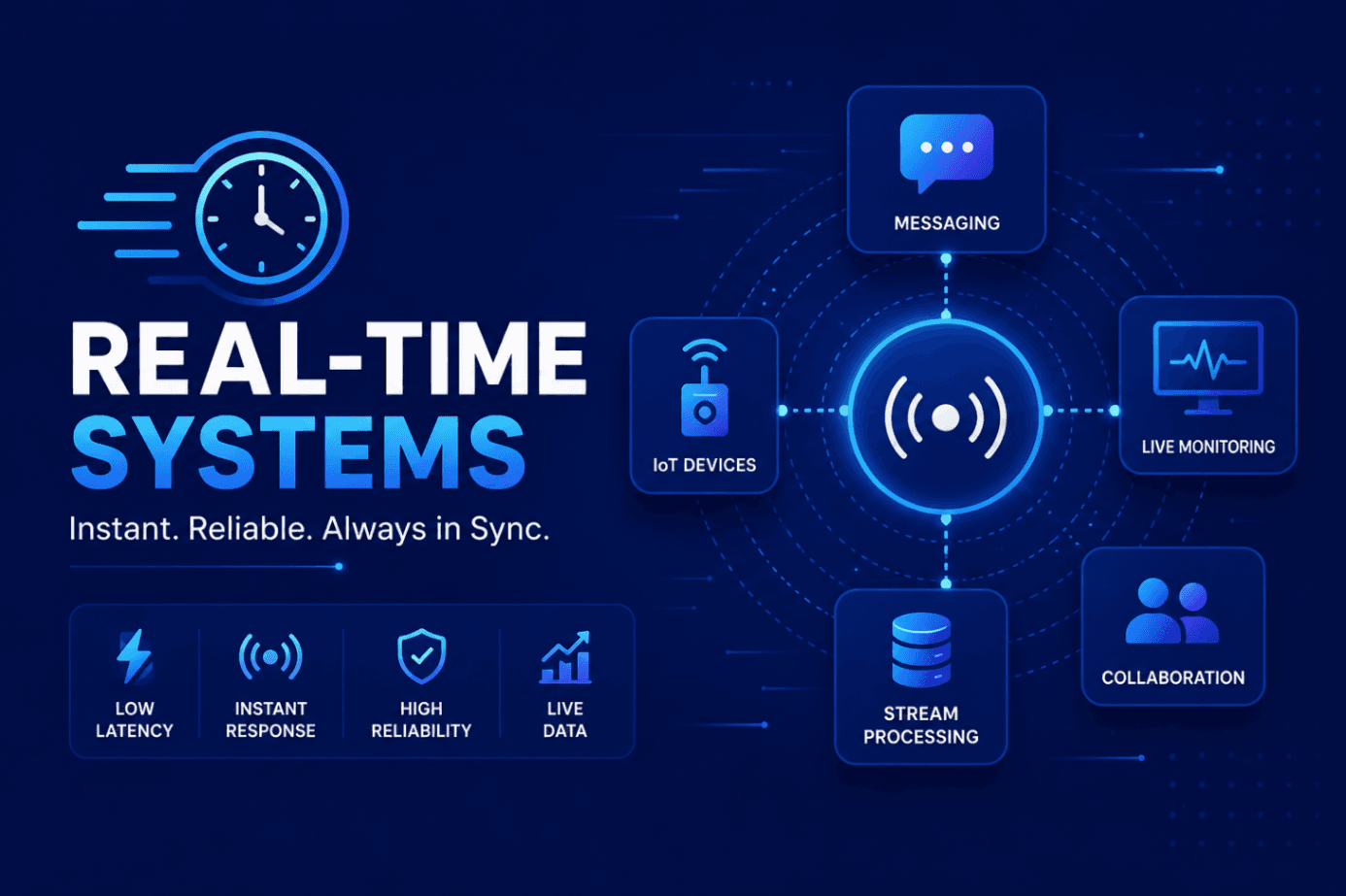
Real-time Systems
Specializing in the development of ultra-low latency applications where speed is the core product. From complex WebSocket architectures for live trading to WebRTC-powered peer-to-peer communication, I build systems that process and deliver data in the blink of an eye

About Real-time Systems
Real-Time Systems: Architecture, Design, and Applications
In standard computing, software is judged primarily by its throughput—how much data it can process over time. But in Real-Time Systems (RTS), correctness depends not just on what the system computes, but on when it delivers the result. A late response is a failed response.
From automotive braking systems and medical monitors to high-frequency trading platforms, real-time systems are engineered to guarantee execution within strict, predictable time constraints.
Hard vs. Soft Real-Time Systems
Real-time systems are broadly categorized by the consequences of missing a deadline. Understanding this boundary is the first step in real-time architectural design.
Hard Real-Time Systems
In a hard real-time system, missing a single deadline results in total system failure, catastrophic damage, or loss of life. These systems require absolute determinism.
Examples: Pacemakers, anti-lock braking systems (ABS), aircraft flight control systems, satellite stabilization.
Soft Real-Time Systems
In a soft real-time system, deadlines are critical, but an occasional miss does not crash the system or cause harm. Instead, it degrades the quality of service (QoS).
Examples: Video streaming platforms, online video games, live audio processing, GPS navigation systems.
Firm Real-Time Systems
A close relative to soft real-time; here, missing a deadline makes the data completely useless, but it doesn't cause a catastrophic system failure.
Examples: Financial trading algorithms or robotic assembly line inspection systems where late telemetry data is simply discarded.
Core Pillars of Real-Time System Design
Building software that interfaces reliably with the physical world requires moving away from traditional OS scheduling toward specialized architectures.
1. Determinism and Predictability
A system is deterministic if it responds to inputs in a predictable, consistent timeframe under all operational loads. In traditional operating systems (like standard Linux or Windows), background tasks can interrupt execution unpredictably. Real-time operating systems (RTOS) eliminate this variance.
2. Low and Bounded Latency
Latency is the delay between a stimulus and its response. Real-time systems don't just optimize for the average latency; they focus on minimizing Interrupt Latency and Context-Switch Latency to guarantee a maximum worst-case execution time (WCET).
3. Task Scheduling Algorithms
Unlike generic schedulers that favor fairness among processes, an RTOS uses priority-driven, deterministic algorithms to ensure critical tasks always get the CPU instantly:
Rate Monotonic Scheduling (RMS): A static scheduling algorithm where tasks with shorter execution periods are automatically assigned higher priorities.
Earliest Deadline First (EDF): A dynamic scheduling algorithm that dynamically adjusts priorities based on which task is closest to its deadline.
Common Real-Time Architectural Pitfalls
Designing concurrent, priority-based systems introduces unique concurrency hazards that can stall critical workloads.
Priority Inversion
This occurs when a low-priority task holds a shared resource (like a mutex) needed by a high-priority task. If a medium-priority task preempts the low-priority task, the high-priority task is inadvertently blocked indefinitely.
The Solution: Modern RTOS implementations use protocols like Priority Inheritance or Priority Ceiling to temporarily boost the low-priority task's status until it releases the resource.
Jitter
Jitter is the unwanted variation in the periodic execution of a task. If a sensor reading loop is supposed to run exactly every $10\text{ ms}$, but occasionally executes at $9.8\text{ ms}$ or $10.5\text{ ms}$, the resulting jitter can cause control loop instability.
The Real-Time Tech Stack
To build reliable real-time applications, engineers deploy hardware and software designed to bypass non-deterministic bottlenecks.
Real-Time Operating Systems (RTOS): Microkernel architectures like FreeRTOS, Zephyr, VxWorks, or QNX that provide deterministic task switching.
RT-Preempt Patches: Modifying standard Linux kernels with real-time capabilities (
PREEMPT_RT) for systems requiring complex networking alongside deterministic performance.Hardware Bare-Metal: Writing directly to Microcontrollers (ARM Cortex-M, RISC-V) without an OS layer for maximum control over hardware timers and interrupts.
Explore Advanced Real-Time Systems Tutorials
Ready to design deterministic, zero-failure systems? Dive into our step-by-step guides, embedded driver implementations, and system analysis blueprints below.